About Us
We Make Youth Opportunity Visible, Measurable, and Politically Salient
65% of India is under 35. Their economic futures are shaped by district-level gaps in education, employment, and opportunity—but this data has never been consolidated or made comparable. We're changing that.
THE PROBLEM
India debates youth futures without ground truth
Policy conversations about youth employment, education, and skilling happen at the national and state level—but outcomes are determined at the district level. Until now, no one has built the infrastructure to make these district-level realities visible, comparable, or actionable.
85% of Indian youth still live in the district where they were born. Yet district-level youth outcomes data remains fragmented across siloed government schemes and databases, incomparable across geographies, and invisible to policymakers, employers, and youth themselves.
The result: Youth remain the subject of policy and political debates without systemic measurement or action on the ground.
OUR APPROACH
Four integrated strategies to shift the discourse
We combine civic technology, institutional tracking, grassroots storytelling, and long-term research to create a complete picture of youth opportunity in India—one that connects data to lived experience, and evidence to political urgency.
01
Civic-Tech Platform
YouthPOWER
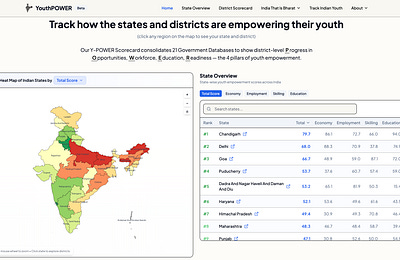
India's 1st district-level youth opportunity map. Consolidates 21 government databases into comparable scorecards across 800 districts, tracking 80+ indicators in education, skilling, employment, and economic readiness.
Explore YouthPOWER
02
Institutional Research
Institutional Tracker
Tracking Parliament's engagement with youth employment. Analysis of 60,000+ parliamentary questions to assess legislative attention, identify gaps on emerging issues like gig work and AI, and surface bipartisan priorities.
Read the Report
03
Storytelling Initiative
Tracking Indian Youth
Humanising district-level data through the lived realities of young Indians. A media fellowship training youth to document their peers' lives across 22 states—bringing grassroots perspectives to national policy debates.
Read the Stories
04
Long-term Analysis
Strategic Research
Deep analysis of structural forces affecting Indian youth: AI governance and employment impact, information ecosystems and platform design, institutional readiness for technological change.
View Research
ORGANIZATION
Building long-term infrastructure for India's youth opportunity
Future of India Foundation is a Section 8 non-profit organization registered under Section 12A and 80G. We are donor-supported and committed to transparency, rigorous research, and impact over scale.
Leadership

Ruchi Gupta
Executive Director
Ruchi Gupta is a public policy practitioner with nearly two decades of experience in democratic governance, institutional reform, and political strategy. As Executive Director of the Future of India Foundation, she is building an institution to address a critical gap in India's political economy: making youth opportunity visible, measurable, and actionable.
Previously, Ruchi led India's largest progressive student and youth organization, with over 4 million registered members. In 2016, she played a key role in securing an amendment to the President's Address in the Rajya Sabha — only the fifth such instance in independent India's history — defending the right of all citizens to contest local elections.
A former McKinsey consultant and Aspen Global Leadership Fellow, she has published over 150 articles on political economy, democratic transitions, and technology governance in all of India's leading national publications.

Dr. Rajiv Kumar
Chairman, Pahle India Foundation; Former Vice Chairman, NITI Aayog

S.M. Vijayanand
Co-Founder, CRISP; Former Secretary, Panchayati Raj & Rural Development

Prof. Niraja Gopal Jayal
Avantha Chair, King's College London

V. Ravichandar
Former Honorary Director, Bangalore International Centre

Suraj Moraje
Eka Foundation; Former Senior Partner, McKinsey; Former Group CEO, Quess Corp
Support Our Work
Help us build the infrastructure India's youth discourse needs—transparent, rigorous, and built for the long term.
Donate Now
Strategic Research
Where Youth Opportunity Intersects with Long-Term Structural Change
Informing institutional design, not short-term advocacy.
AI Governance & Employment
How will artificial intelligence reshape labour markets for young Indians? We examine employment impact, institutional readiness, and the challenge of governing AI in a democracy.
Featured Research
Governing AI in India: Why Strategy Must Precede Mission
Read the Report →
Information Ecosystems
How do platform design and information flows affect young Indians as citizens and consumers? We analyse policy responses and the position of youth as both subjects and shapers of digital public spheres.
Featured Research
Politics of Disinformation: Why Current Approaches Are Geared to Fail
Read the Report →
Support This Research
Independent analysis on AI governance, information ecosystems, and youth opportunity.
Support Us
Support Our Work
The Future of India Foundation is an independent, non-partisan institution. We rely on grants, institutional partnerships, and individual contributions to sustain our research and platforms.
What Your Support Makes Possible
YouthPOWER
Maintaining and expanding India's only district-level youth opportunity platform. Keeping it open-access and free.
Institutional Tracker
Independent research on legislative responsiveness and institutional performance.
Tracking Indian Youth
Training young journalists and amplifying grassroots voices in national policy debates.
Strategic Research
Long-term analysis of AI, technology, and democratic institutions.
For Indian Donors
Donations are eligible for tax deduction under Section 80G of the Income Tax Act, 1961.
Registration: Section 8 Company | 12A & 80G Certified
Donate Now
Support independent research and open-access platforms for India's youth.
Partner With Us
For institutional partnerships, grants, or large contributions, please get in touch.
Contact Us
CAREERS
Build the Infrastructure for India's Youth Opportunity
Join a mission-driven team creating civic technology, research, and storytelling that makes youth futures visible and actionable.
WHY FUTURE OF INDIA FOUNDATION
Why Work With Us
We're doing some of the most interesting and high-impact work on youth opportunity and democratic engagement in India. You will get an opportunity to learn about our country and contribute to nationbuilding, while learning new skills and hopefully having fun.
Learn About Your Country
Understand India's complexity and diversity - youth aspirations, state institutions and ground realities - through hands-on research and engagement.
Contribute to Nation-Building
Work on India's most interesting and urgent challenge: making youth opportunity visible, measurable, and politically salient.
Build Lasting Civic Infrastructure
Create platforms like YouthPOWER that will serve policymakers, journalists, and citizens for years to come.
OPEN POSITIONS
Current Opportunities
Interested in Our Work?
We're building a team—and community—committed to nation-building by expanding youth opportunity through civic engagement, tech for good, and institutional reform. If you combine strategic vision with operational grit—and understand India's messy reality—please reach out. Paid and volunteer roles available.
Send us your CV and interests →




Below is a selection of recent writing on India's political economy, youth futures, and democratic governance. For the latest analysis and to receive updates directly in your inbox, visit and subscribe on Substack.